Story Seeds
Dan has hit me with several intriguing story ideas lately. When he told me where they came from, I thought it would make a good newsletter column. He wrote it up and here it is:
What is a clockmaker doing in a spaceport? This particular clockmaker is unassuming but innovative, crafting ornate atomic timepieces of exquisite quality. He has become aware of a conspiracy to steal an ancient prototype of a small nuclear reactor of immense power. He is part of a daring plan to prevent the theft of this artifact but the result will disrupt the flow of time on the station and make it impossible for him to ever make reliable clocks here again.
This "Story Seed" was generated by a deck of cards called The Story Engine, a system of story telling prompts designed by Peter Chiykowski. The unembellished draw of cards is pictured above, a jumping-off point to start spinning the story.
The Story Engine deck helps writers, roleplaying gamemasters, and anyone looking for ideas to unlock their creativity for a plot, scene, encounter, adventure, backstory, etc. Although several of these products are out there, this one is particularly easy to use and remarkably flexible. It has a range of ways to use the cards and several expansion packs to tailor the outcomes to different genres. For instance, the previous sample was generated using a combination of the core set plus the science fiction and steampunk add-ons.
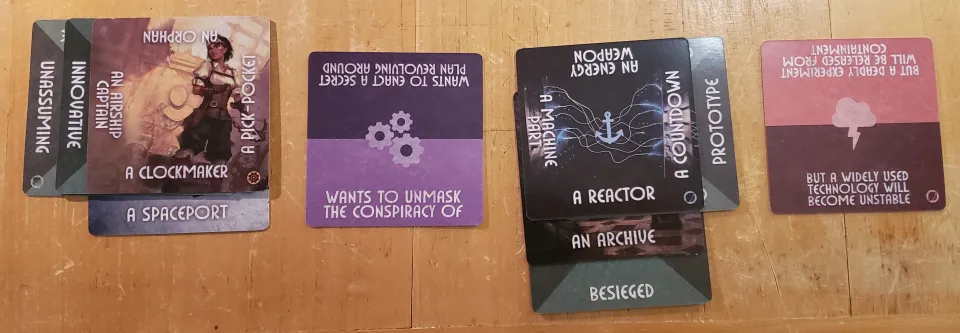 Cards from the Story Engine
The deck isn't designed to write for you, but it can generate ideas that may help get you started, break through writer's block, or help you consider directions that might not have otherwise occurred to you.
Another example with the same configuration yielded:
> A haunted cartographer and a fortune-telling automaton want to change the past by using a miraculous key to a dormant mechanism, but first they must reconcile with an old enemy, a government-backed artifact dealer.
The core deck includes 180 cards, divided into five types of 36 each, all of which have multiple words that can be selected from, yielding an immense number of possibilities. There are:
- Agents - People who can be characters
- Engines - Motivations and relationships
- Anchors - Items, places, and other foci
- Conflicts - Statements that throw a wrench in things, or that give characters challenges to surmount
- Aspects - Descriptive words to apply to other cards, used by tucking them partially under their target cards
The Agent and Anchor cards also include interesting artwork that provides yet more opportunities for inspiration.
The guide that comes with the deck suggests that you can use the cards as a straightforward story seed, a character concept, an item- or setting-driven story, a clash of wills where two characters are facing off against each other, or even as a collaborative storytelling experience with a group. You can draw multiple times and choose the set of cards from all those drawn that best fits the needs. The main point of using the deck is to CREATE something. You could also start with certain cards if you want to seed the card draw with a pre-defined situation.
Expansion decks for Horror, Fantasy, and Science Fiction, and smaller "boosters" include Cyberpunk, Dystopian, Eldritch Horror, Mythology, Post-Apocalyptic, and Steampunk. I would draw cards from one or more decks, and choose the combinations that worked best.
Ultimately my clockmaker didn't end up saving an ancient nuclear reactor, but that story seed did send me on a mental journey that has vastly improved a completely different story idea, set very far from any spaceport!
For more information, check out The Story Engine site, which includes videos of the deck in action: https://storyenginedeck.myshopify.com/
Cards from the Story Engine
The deck isn't designed to write for you, but it can generate ideas that may help get you started, break through writer's block, or help you consider directions that might not have otherwise occurred to you.
Another example with the same configuration yielded:
> A haunted cartographer and a fortune-telling automaton want to change the past by using a miraculous key to a dormant mechanism, but first they must reconcile with an old enemy, a government-backed artifact dealer.
The core deck includes 180 cards, divided into five types of 36 each, all of which have multiple words that can be selected from, yielding an immense number of possibilities. There are:
- Agents - People who can be characters
- Engines - Motivations and relationships
- Anchors - Items, places, and other foci
- Conflicts - Statements that throw a wrench in things, or that give characters challenges to surmount
- Aspects - Descriptive words to apply to other cards, used by tucking them partially under their target cards
The Agent and Anchor cards also include interesting artwork that provides yet more opportunities for inspiration.
The guide that comes with the deck suggests that you can use the cards as a straightforward story seed, a character concept, an item- or setting-driven story, a clash of wills where two characters are facing off against each other, or even as a collaborative storytelling experience with a group. You can draw multiple times and choose the set of cards from all those drawn that best fits the needs. The main point of using the deck is to CREATE something. You could also start with certain cards if you want to seed the card draw with a pre-defined situation.
Expansion decks for Horror, Fantasy, and Science Fiction, and smaller "boosters" include Cyberpunk, Dystopian, Eldritch Horror, Mythology, Post-Apocalyptic, and Steampunk. I would draw cards from one or more decks, and choose the combinations that worked best.
Ultimately my clockmaker didn't end up saving an ancient nuclear reactor, but that story seed did send me on a mental journey that has vastly improved a completely different story idea, set very far from any spaceport!
For more information, check out The Story Engine site, which includes videos of the deck in action: https://storyenginedeck.myshopify.com/